'I am in your dreams, but you are not in mine' exhibition view.
Photo © Ollie Harrop.
Photo © Ollie Harrop.
I am in your dreams, but you are not in mine
2025
I am in your dreams, but you are not in mine is a new exhibition and commission by the collective Planetary Portals (including Michael Salu of House of Thought) at The Photographers’ Gallery from 7 March 2025. Interrogating archival photography and artificial intelligence (AI), the exhibition weaves together the environmental landscapes of 19th-century mining of gold and diamonds in South Africa with the scripting process of AI.
The exhibition asks how have diverse languages become compressed into one singular coding language and questions whose voices are not allowed to speak through the colonial archive. Whose voices are silenced, whose lives erased, and what materials cannot be archived?
Bringing a decade of machine learning research and two decades of photography experience, Michael Salu created a series of single-shot films that use a variety of generative AI and digital processes, crafted from archival photographs sourced from the Papers of Cecil Rhodes at the Bodleian Library, University of Oxford. Photography was an essential technology of imperial communication and a space of trespass and refusal, where subjects challenged the present and intent of colonial place-making.
The photographs in the exhibition provide a visual vocabulary of the “environment” of Rhodes and his legacy – from his origins in Hackney, East London to the diamond fields of South Africa – and provide a “portal” for critically engaging with the extractive logics of AI. The resulting works offer new narratives by exposing the gaps in large language models (LLMs) and the structural racial logics of universal norms.
Presented alongside the films are lists of African languages currently omitted from the training of Large Language Models (subject to change).
Inverting the language learning model hallucinatory methodology, we implement an interactive dialogue to coax out the machine's knowledge gaps, directing the temporal resistances in and around the filmed photographs. We intervene in 'ground truths' with our custom (human-written) inferences developed as text, soundscapes and resistant images, which interrogate the hallucinatory inferences of large language models. Our interventions symbolise resisting automation and disrupting renderings of spatial and temporal patterns that sustain the current planetary condition.
The development method involves several overlapping and back-and-forth processes between analogue and digital, 2D and 3D, code and tools, image and text.
So to ensure coherent pieces and to render our concept clearly, we set some constraints for the process:
The development method involves several overlapping and back-and-forth processes between analogue and digital, 2D and 3D, code and tools, image and text.
So to ensure coherent pieces and to render our concept clearly, we set some constraints for the process:
- One shot of the photographic frame
- Using immediate generative outputs
- Intuitive non-linear edits. Repetition as a mode of being.
- The wilder variable, a series of animations as human and inhuman resistance

Breakdown of the film concept
The films develop a (colonial) cybernetic method that interrogates connections between colonial photography and AI in four discrete steps:
1 Photograph.
Photography served as a powerful imperial technology. Settlers commissioned albums to capture vast, seemingly empty landscapes.
Nothing is as it seems: while the photographs show white subjects in a triumphalist mood, they also create a shadow of those silenced by white supremacy.
Photography served as a powerful imperial technology. Settlers commissioned albums to capture vast, seemingly empty landscapes.
Nothing is as it seems: while the photographs show white subjects in a triumphalist mood, they also create a shadow of those silenced by white supremacy.
Pastoral Landscape
She has been nominated for an Academy Award, two Grammy Awards, and the Mercury Prize
2 Re/script
The texts that appear at the bottom of the films write into the negative spaces of the image. Combined with sections of the archival photographs, this text is fed into several large language models (LLMs). The unedited assumptions output by these LLMs are then presented.
The text, as seen in the films and by the machine, holds a conflict. It both erases and repairs.
The texts that appear at the bottom of the films write into the negative spaces of the image. Combined with sections of the archival photographs, this text is fed into several large language models (LLMs). The unedited assumptions output by these LLMs are then presented.
The text, as seen in the films and by the machine, holds a conflict. It both erases and repairs.
Pastoral Landscape
She has been nominated for an Academy Award, two Grammy Awards, and the Mercury Prize
3 Hallucinate
The archive photograph combined with the texts, becomes a puzzle that the LLMs attempt to solve with pattern recognition, exposing how its ‘solutions’ are founded on historical racial logics of subjugation, erasure and expulsion.
The outputs are painted into compositions which become counterintuitive to western visual culture, drawing attention to what goes unseen.
The archive photograph combined with the texts, becomes a puzzle that the LLMs attempt to solve with pattern recognition, exposing how its ‘solutions’ are founded on historical racial logics of subjugation, erasure and expulsion.
The outputs are painted into compositions which become counterintuitive to western visual culture, drawing attention to what goes unseen.
Pastoral Landscape
She has been nominated for an Academy Award, two Grammy Awards, and the Mercury Prize
4 Resist
Layered across the films are manual animations foregrounding the sensory poetics of landscapes, weather and bodily movements.
The animations reinscribe the image with emotions and human agency erased by colonial memory.
Layered across the films are manual animations foregrounding the sensory poetics of landscapes, weather and bodily movements.
The animations reinscribe the image with emotions and human agency erased by colonial memory.
Pastoral Landscape
She has been nominated for an Academy Award, two Grammy Awards, and the Mercury Prize
The prosenium visual concept
“And above all beware, my body and my soul too, beware of crossing your arms in the sterile attitude of the spectator, because life is not a spectacle, because a sea of sorrows is not a proscenium, because a man who screams is not a dancing bear. "Cahier d'un retour au pays natal (Notebook of a Return to the Native Land) Aimé Césaire, 1939
“And above all beware, my body and my soul too, beware of crossing your arms in the sterile attitude of the spectator, because life is not a spectacle, because a sea of sorrows is not a proscenium, because a man who screams is not a dancing bear. "Cahier d'un retour au pays natal (Notebook of a Return to the Native Land) Aimé Césaire, 1939
As a conceptual framing, we utilise the proscenium as a two-pronged concept.
1. A quote from Aime Cesaire's Notebook of a Return to the Native Land, significant to our expanding reading list.
2. Using the proscenium as a way of extending narrative within a fixed frame, adding a series of two and three-dimensional interacting layers of elements.
1. A quote from Aime Cesaire's Notebook of a Return to the Native Land, significant to our expanding reading list.
2. Using the proscenium as a way of extending narrative within a fixed frame, adding a series of two and three-dimensional interacting layers of elements.
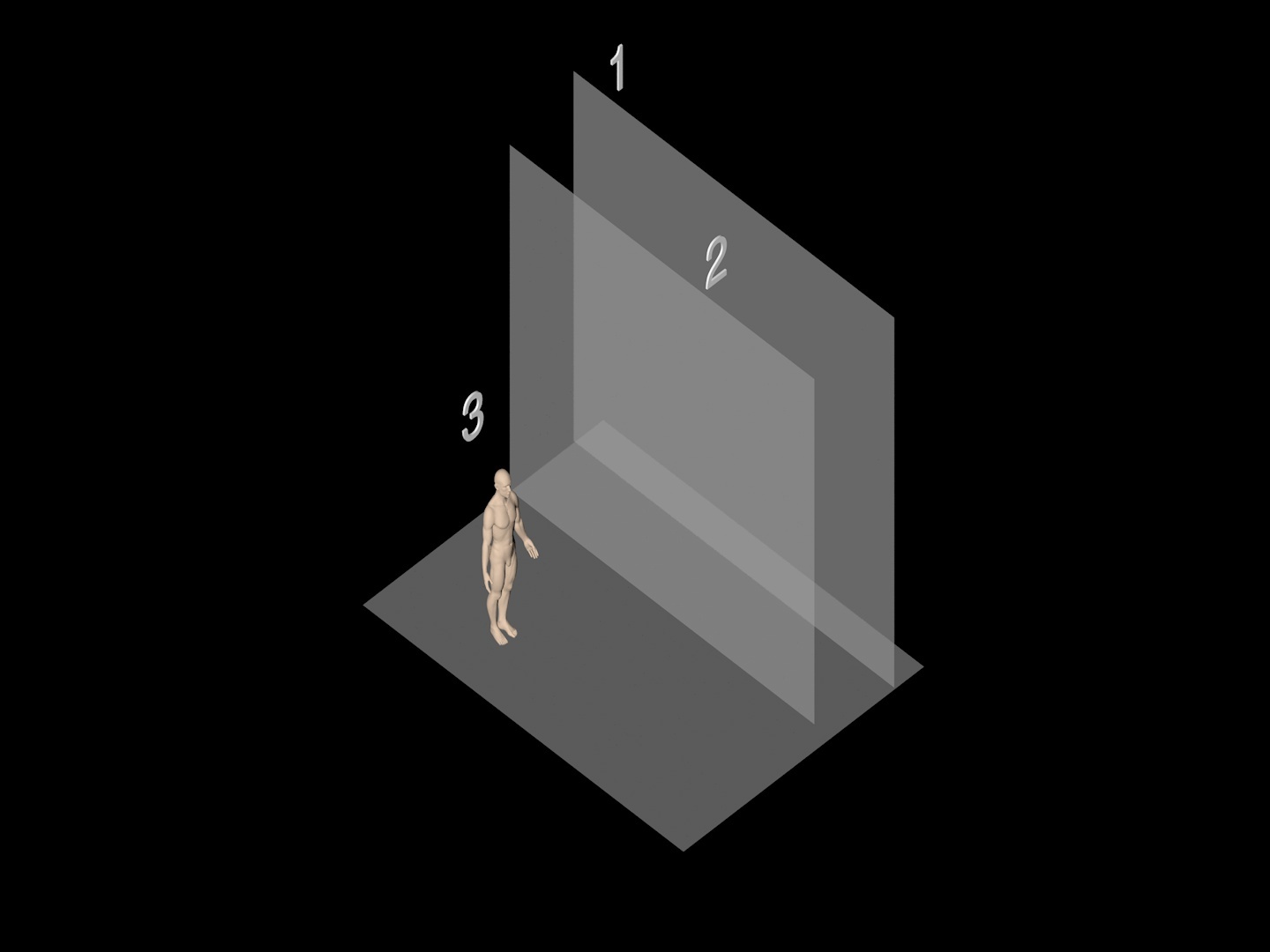
Proscenium testing and design.
The animations were developed using motion capture and Unity, a game engine and filmmaking software.
Artist Talk: Planetary Portals
Find out more about the project
Credits
- Creative and technical lead: House of Thought
- Writing and research: Planetary Portals
- Artistic concept creation and film direction: House of Thought
- ML/AI development: House of Thought
- Game engine design and animation: House of Thought
- Motion capture animation: House of Thought
- Editing and post-production: House of Thought
- Cinematography and art direction: House of Thought
- Sound design © Kyprian Rainey
- Exhibition installation design: House of Thought, Planetary Portals
TO KEEP UP TO DATE WITH MY ARTICLES,
PLEASE CONSIDER JOINING MY MAILING LIST OR FOLLOW ME
PLEASE CONSIDER JOINING MY MAILING LIST OR FOLLOW ME
